
You walk into the kitchen with a purpose. Then someone asks a question. The dog barks. You notice an unopened envelope.
Now you are standing beside the refrigerator wondering why you came.
Or you ask your child to put away the backpack, wash their hands, and bring you a school form. Five minutes later, the backpack is on the floor, the child is eating crackers, and the form has vanished.
These moments can leave everyone frustrated. Understanding working memory gives us a better place to begin.
The brain’s temporary workspace
Working memory lets us hold information in mind while doing something with it. We use it to follow a recipe, work through a math problem, remember the beginning of a sentence while reading the end, and keep a goal in mind as we act.
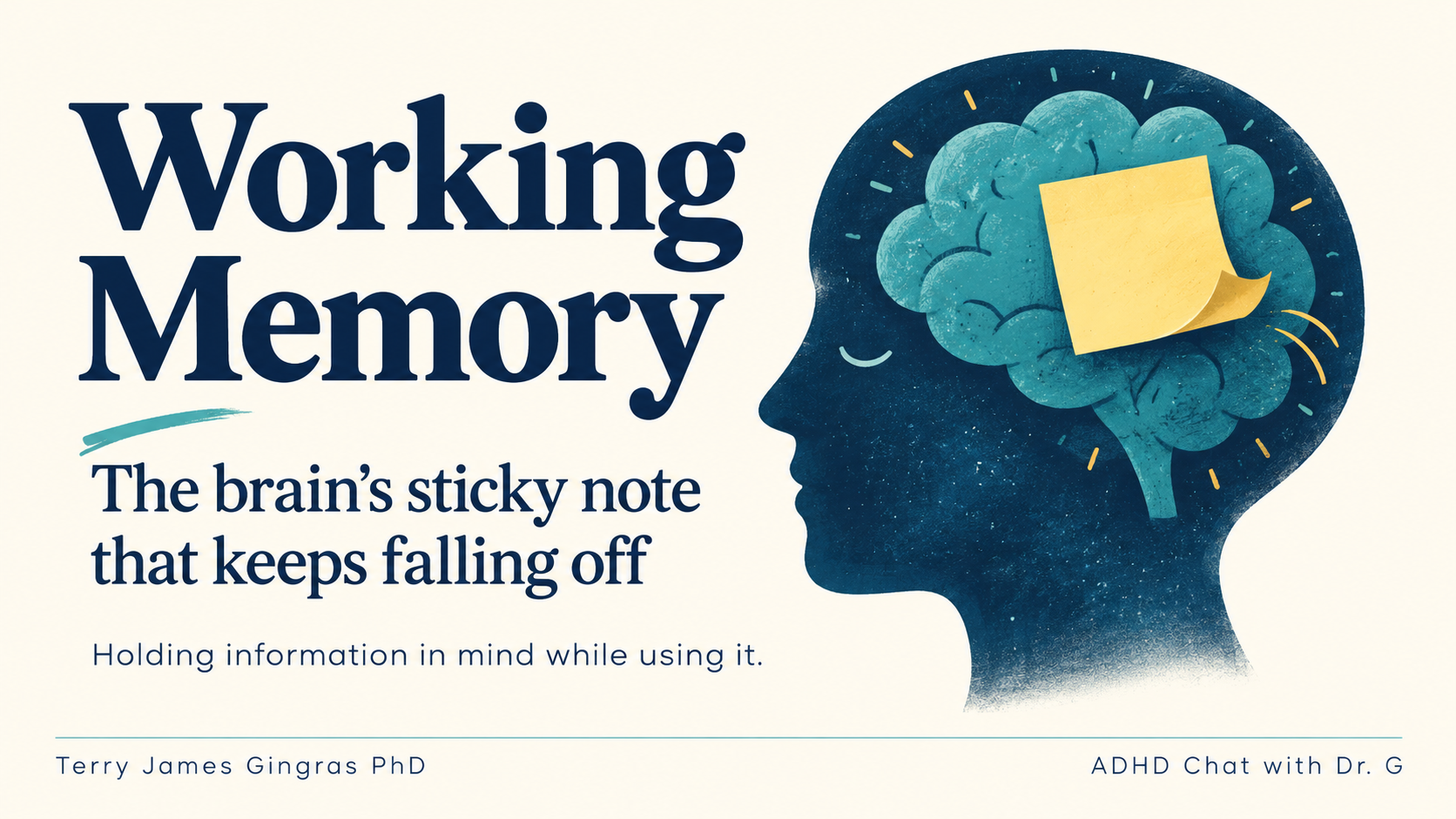
Think of it as the brain’s sticky note: “Here is what I am doing. Here is what comes next.”
The metaphor has limits. Working memory involves several interacting processes, rather than one storage spot. But the image captures something familiar: a thought can be available one moment and difficult to retrieve the next.
Research finds working-memory difficulties in children and adults with ADHD, although the pattern and severity vary. A person’s diagnosis alone does not tell us their particular strengths or difficulties.
“But you remembered that!”
A child may remember astonishing details about dinosaurs yet lose track of a two-step instruction. An adult may recall a vacation from twenty years ago yet forget what they intended to say during a meeting.
Those tasks make different demands. Stored knowledge and memories differ from the temporary mental workspace we use during an activity.
Remembering something interesting does not establish that someone can reliably hold several instructions in mind while distractions compete for attention.
At the same time, every lapse does not come from working memory. Sometimes information never received enough attention to register. Sometimes the challenge involves remembering to act later. We need curiosity before conclusions.
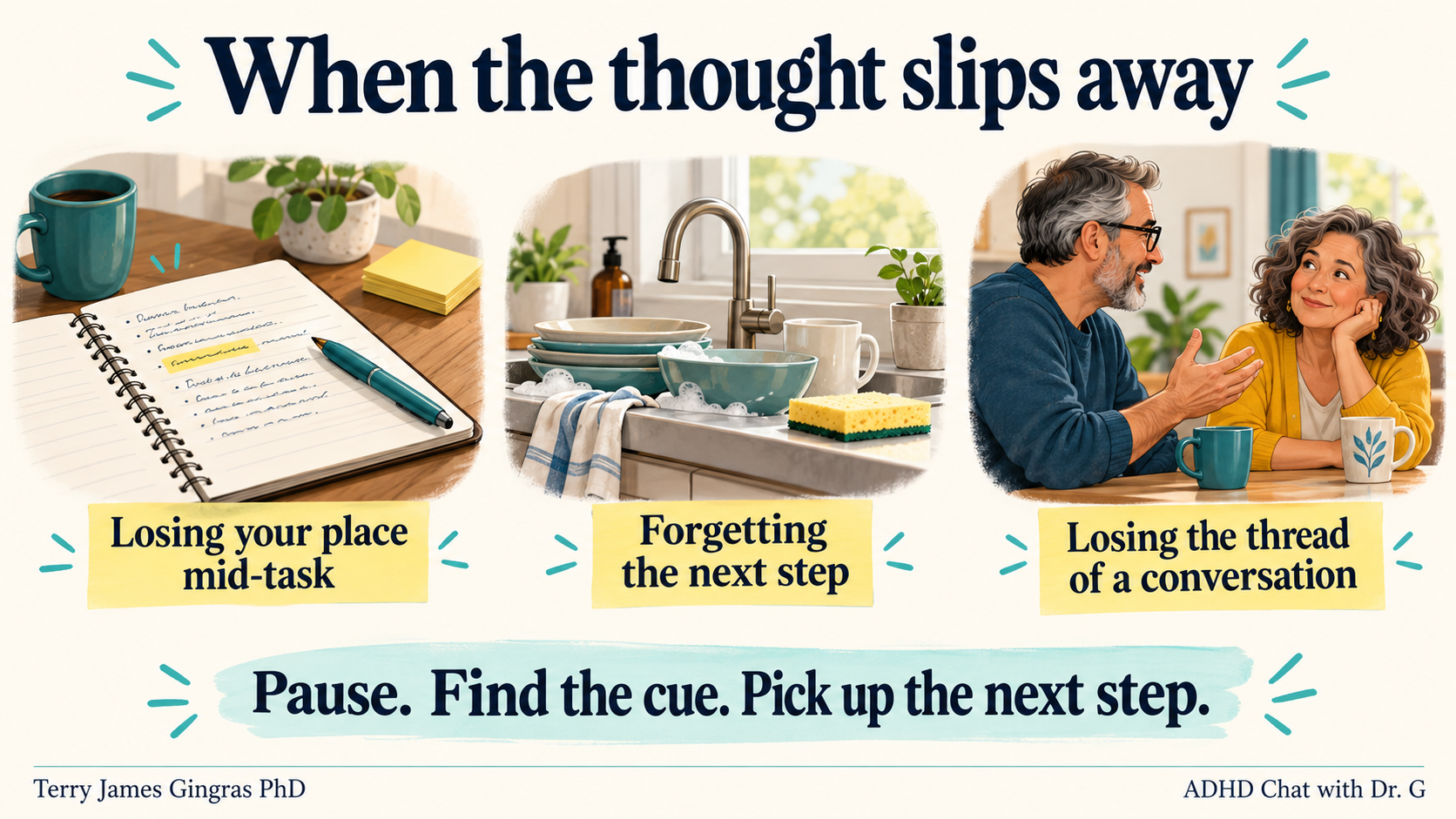
When a missing thought becomes a relationship problem
Consider what happens when someone says, “I already told you.”
The speaker may hear forgetfulness as evidence that they do not matter. The person who forgot may feel embarrassed, defensive, or defeated.
The missed task still needs attention. Understanding the difficulty helps us choose a useful response.
Try: “What would help us keep track of this?”
For a child, that might mean a short checklist beside the backpack. For partners, it might mean entering an agreement into a shared calendar before the conversation ends.
The goal is dependable follow-through, with a system both people understand.
Give the thought somewhere to land
Start by reducing how much must stay in someone’s head.
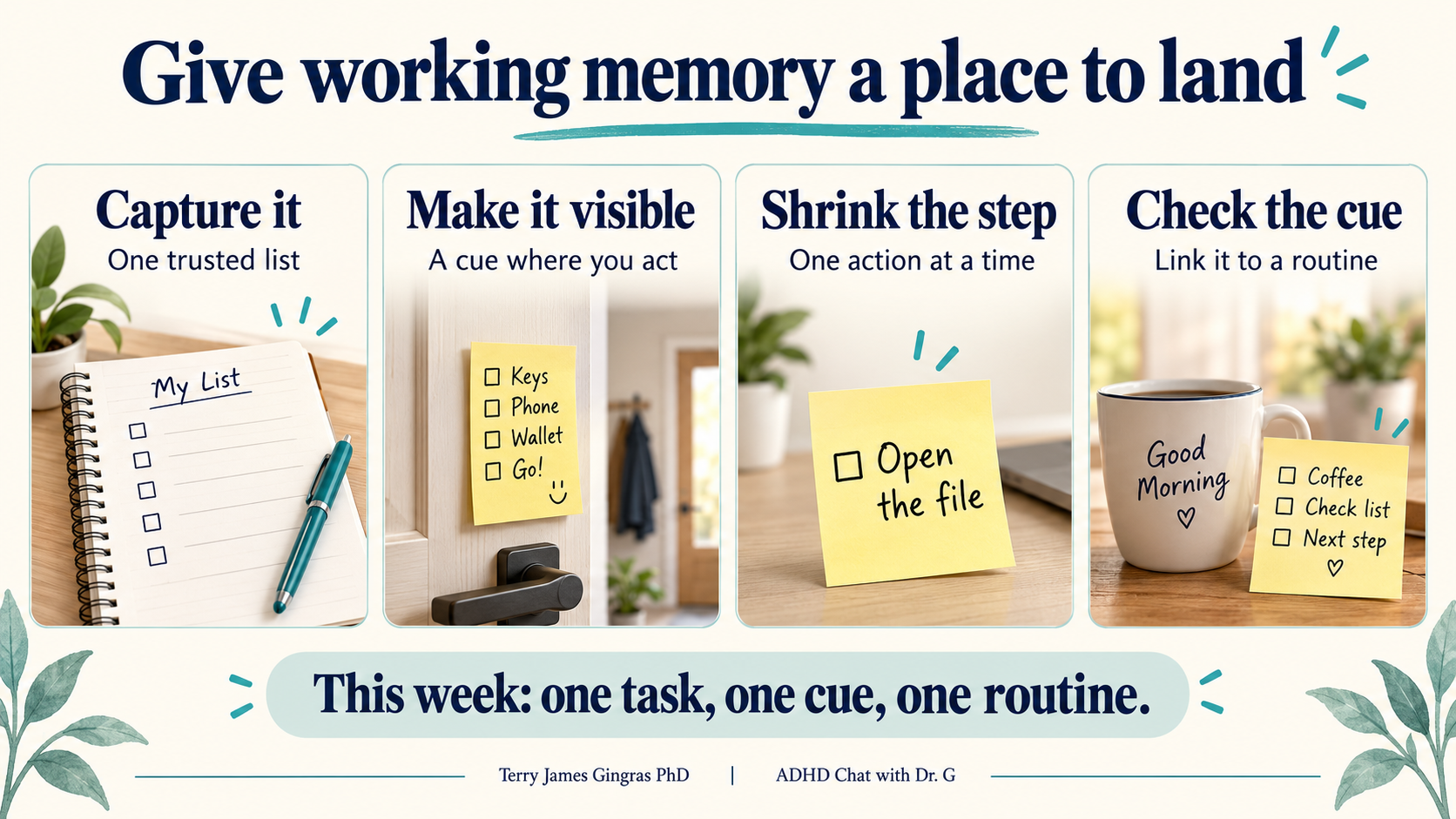
Capture information immediately. Choose one main place for tasks: a notebook, a simple app, or a household board. Five competing systems can create another search problem. Record the task while it is still present.
Make the next action specific. “Get organized” offers little direction. “Put the school form in the blue folder” gives the person a clear action they can recognize and complete.
Keep instructions manageable. Offer one step, or a short written sequence suited to the person. Ask, “What is your first step?” This checks whether you communicated clearly and gives you a chance to correct misunderstandings.
Place cues where action happens. Put the departure checklist near the door. Keep the meeting agenda open during the meeting. A reminder tucked inside a closed drawer has little chance to help.
Leave a breadcrumb before switching tasks. Before answering the phone, jot down, “Next: attach the invoice.” That small note can make returning easier.
Build checking into a routine
Writing something down is only half the job. The information must become available again when it matters.
Link checking the list to an established event: after breakfast, before leaving home, or when opening the computer. Keep the list short enough to use.
Review missed tasks without a lecture. Ask whether the cue was visible, the step was clear, and the timing made sense. Then adjust the system.
This week’s experiment
Choose one recurring snag: leaving without lunch, losing your place during paperwork, or forgetting a school item.
Create one visible cue. Connect it to one routine. Try it for seven days.
Notice what improves and where the system breaks down. Let that information guide your next adjustment.
You do not have to hold every intention in your head to take responsibility for it. You can give it a reliable place to wait.
For help building practical ADHD supports for yourself or your family, schedule a discovery coaching call at terrygingrasphd.com
Responses