
Why ADHD Is a Difference in Brain Function—Not a Defect in Character
"People with ADHD don't have a deficit of intelligence. They have a deficit in the brain systems that consistently translate intention into action."
If you've lived with ADHD—or loved someone who has—you've probably heard comments like these:
"You just need to try harder."
"You're so smart. Why don't you apply yourself?"
"You could do it if you really wanted to."
After nearly four decades as a clinical neuropsychologist, I can tell you that those statements miss the point entirely.
ADHD is not a disorder of intelligence, motivation, or character. It is a disorder of brain regulation. The ADHD brain is organized differently, develops differently, and processes information differently. Understanding those differences changes how we evaluate ourselves, our children, and our expectations.
One of the greatest advances in neuroscience over the past thirty years has been moving away from asking, "What's wrong with this person?" to asking, "How is this brain wired?"
That shift matters.
The CEO of the Brain
Imagine a successful company with brilliant employees but an ineffective chief executive officer. Every department works hard, but projects are delayed, priorities constantly change, important details fall through the cracks, and everyone reacts to the latest crisis instead of following a plan.
That company doesn't have a talent problem.
It has a management problem.
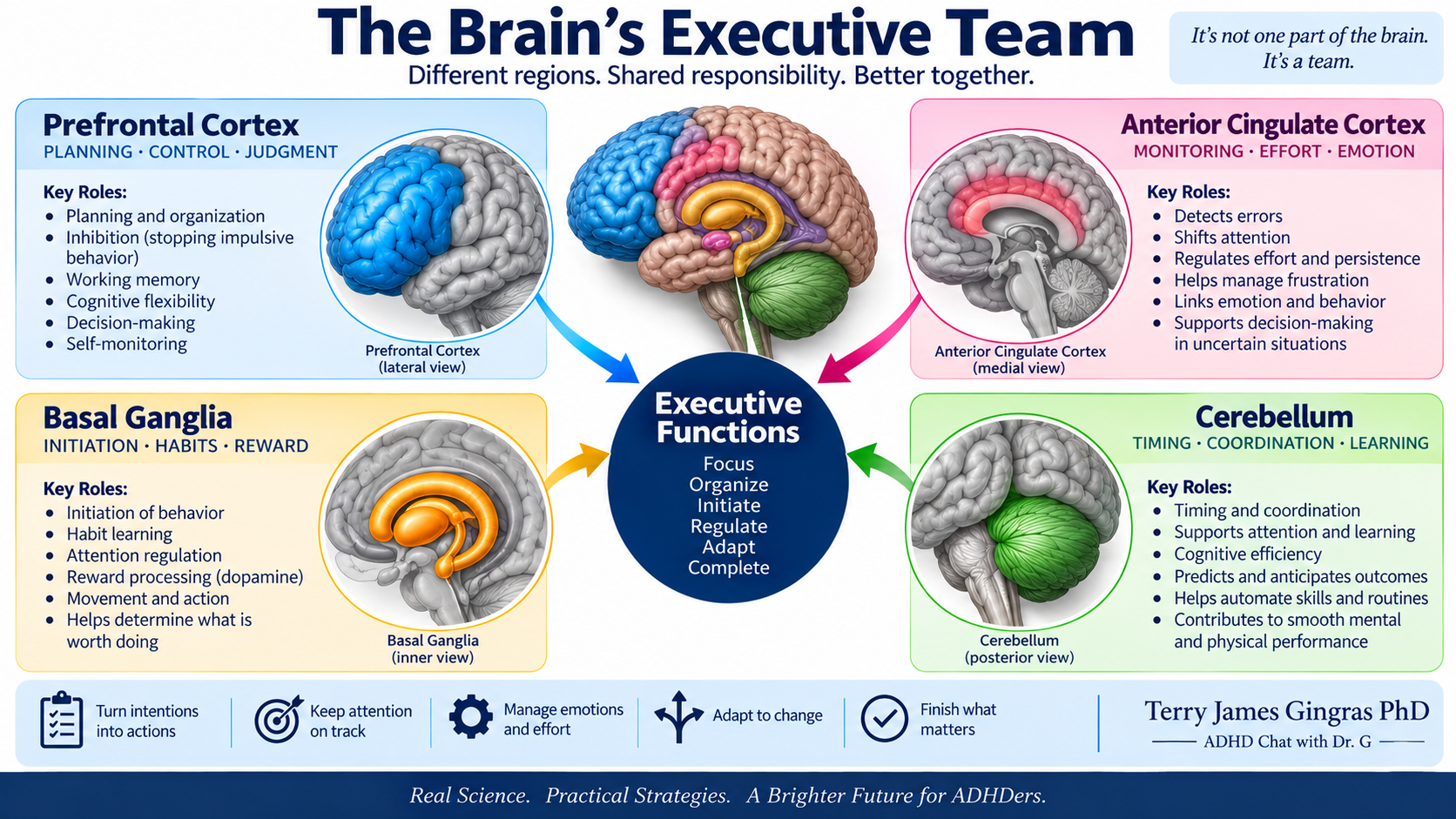
The prefrontal cortex functions as the brain's chief executive officer. Located just behind the forehead, it coordinates planning, prioritizing, working memory, emotional control, decision-making, and self-monitoring—skills collectively known as executive functions.
These are precisely the abilities most affected in ADHD.
This explains one of the greatest frustrations experienced by people with ADHD: they usually know what they should do. The challenge is getting the brain to do it consistently.
Knowledge isn't the problem.
Execution is.
ADHD Is a Network Disorder
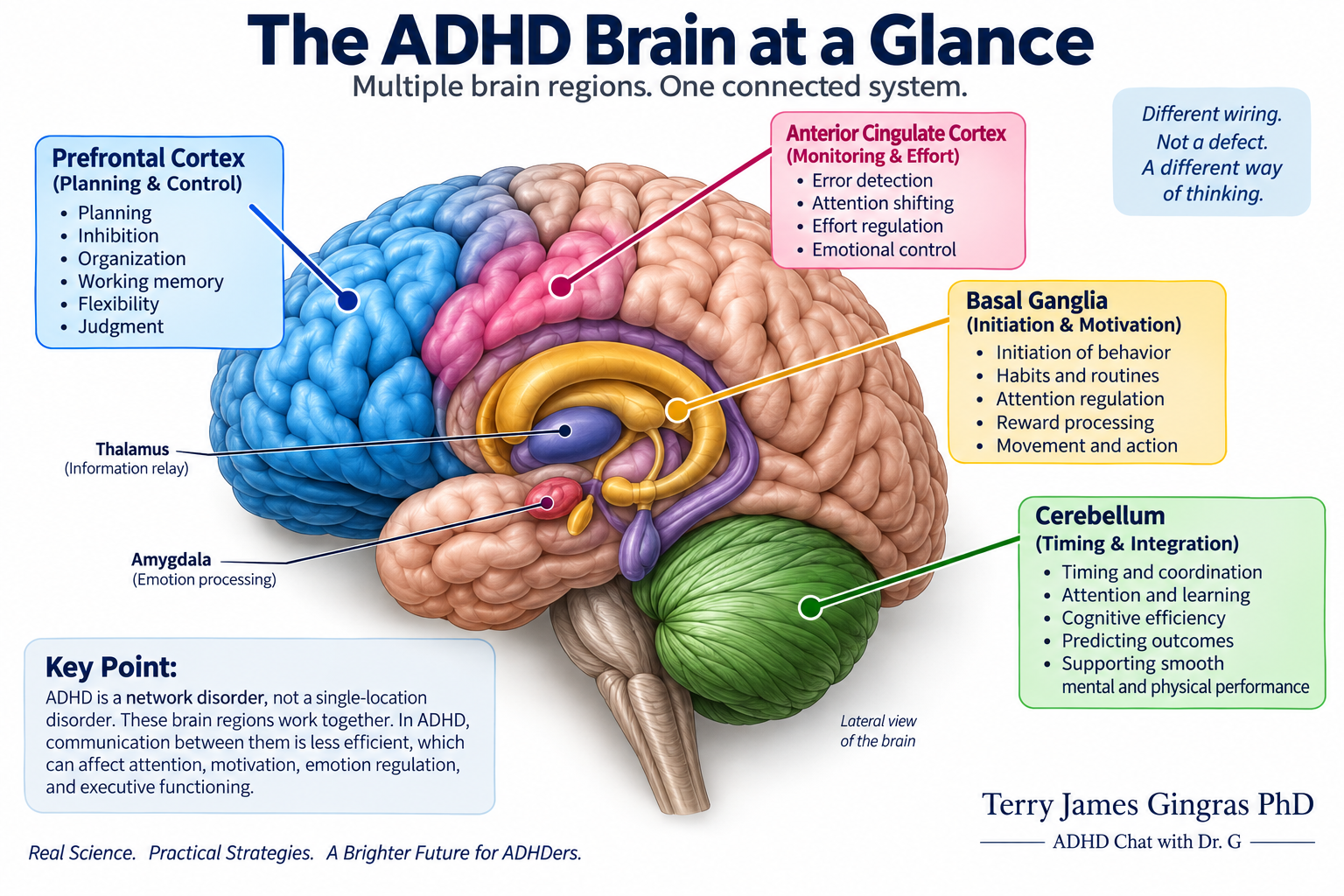
For years, researchers searched for a single "ADHD center" in the brain. We now know there isn't one.
Instead, ADHD involves several interconnected brain networks that communicate less efficiently than they do in people without ADHD.
Among the most important are:
-
The prefrontal cortex, responsible for planning, inhibition, organization, and judgment.
-
The basal ganglia, which help regulate movement, habits, attention, and the initiation of behavior.
-
The cerebellum, traditionally associated with coordination but now recognized as playing an important role in timing, attention, and cognitive efficiency.
-
The anterior cingulate cortex, which helps detect errors, shift attention, and regulate effort.
Think of these regions as members of an orchestra. In the neurotypical brain, the sections generally stay in rhythm. In ADHD, the musicians are all talented, but the timing between sections is less consistent. The result is not a lack of ability—it is inconsistent performance.
Chemistry Matters Too
Structure tells only part of the story.
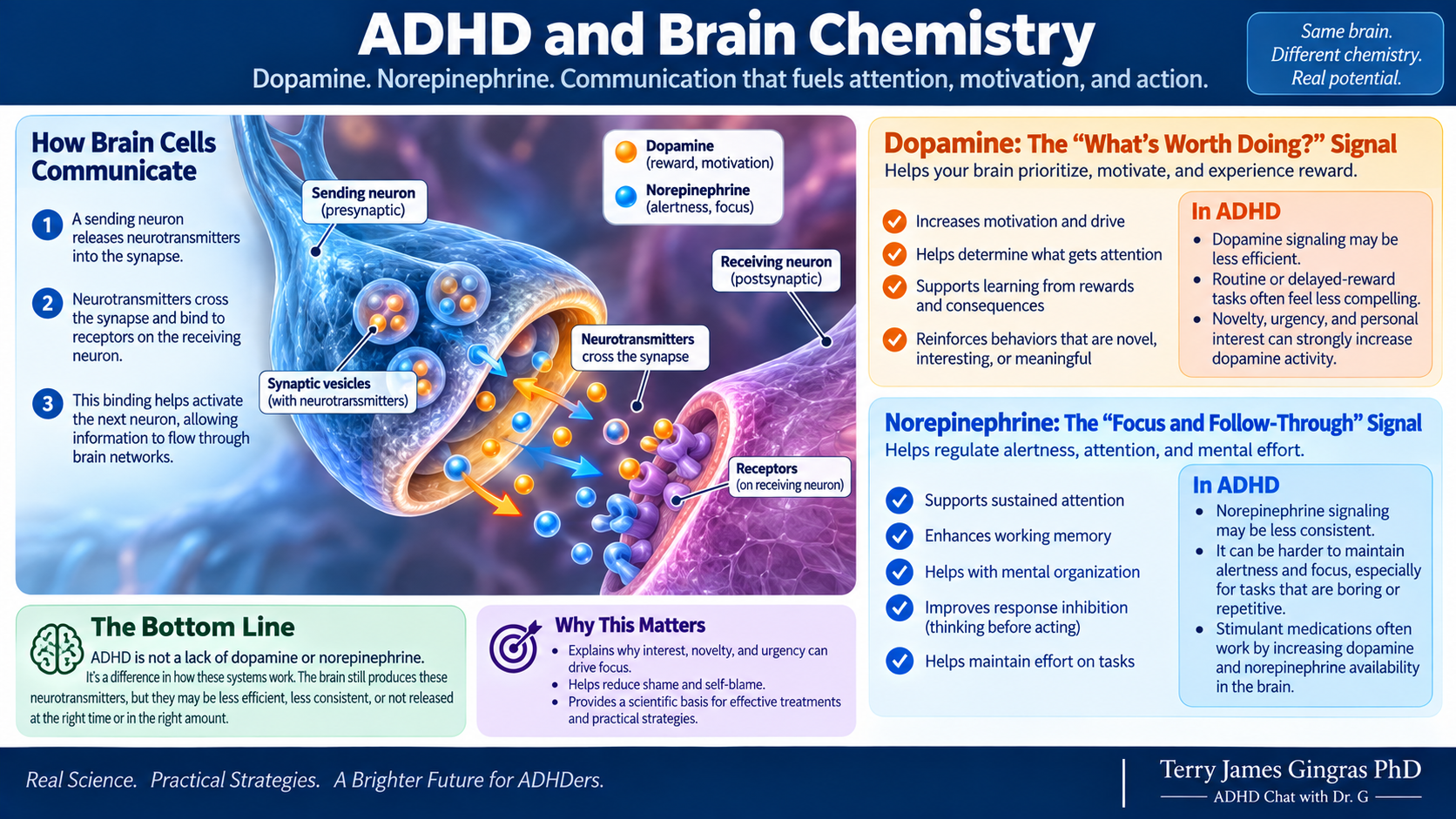
Communication between brain cells depends on chemical messengers called neurotransmitters. Two of the most important in ADHD are dopamine and norepinephrine.
Dopamine helps the brain decide what deserves attention and effort. Norepinephrine supports alertness, focus, and mental organization.
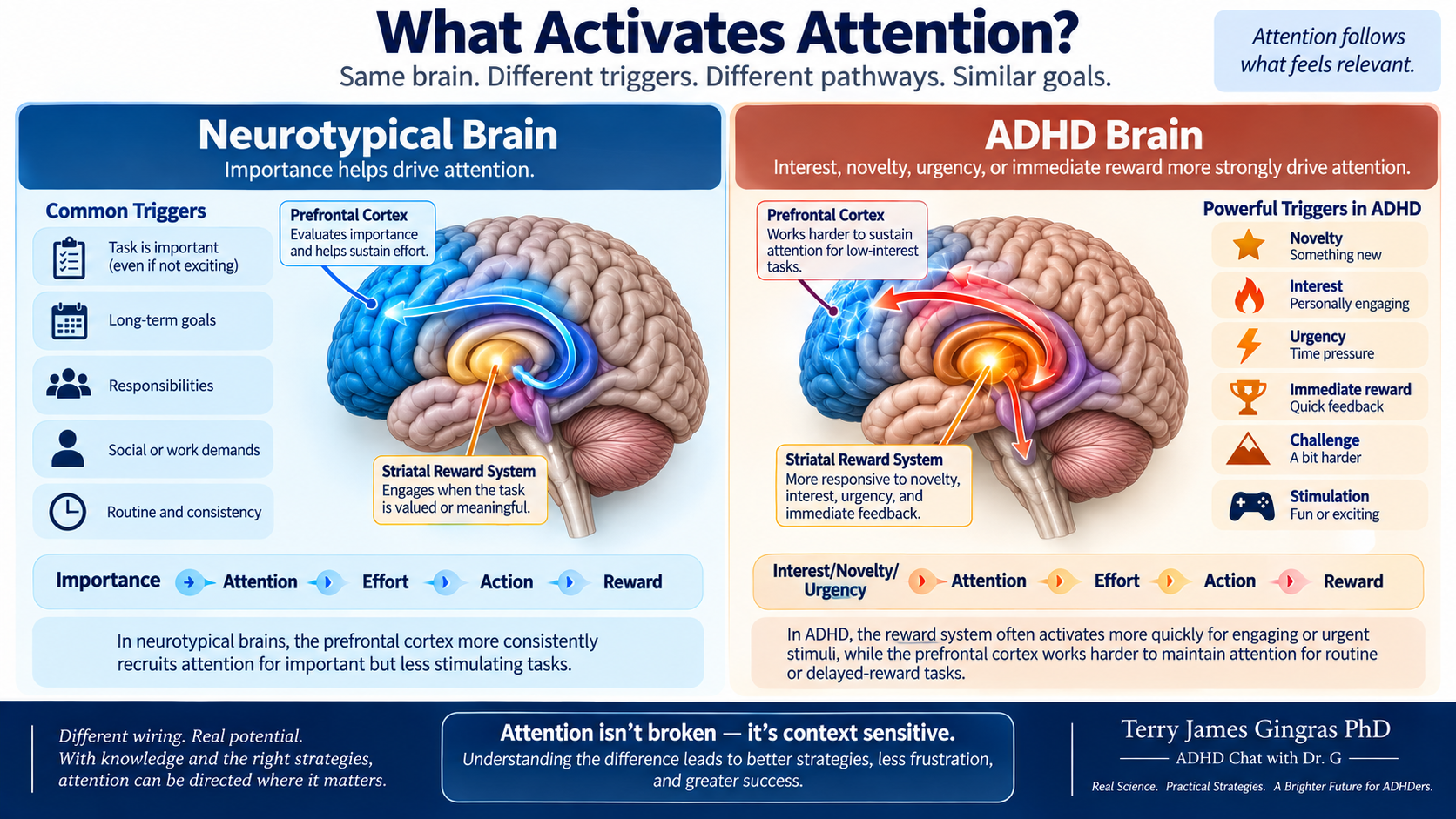
When these systems are less efficient, the ADHD brain struggles to maintain attention for routine or delayed-reward tasks. Yet the same brain may become intensely focused on an activity that is novel, urgent, personally meaningful, or highly stimulating.
This isn't laziness or selective motivation.
It's neuroscience.
Why ADHD Looks So Inconsistent
Parents often ask me, "How can my child spend three hours building a complex Minecraft world but can't work on homework for fifteen minutes?"
Adults ask a similar question: "How can I successfully run a company but forget to pay my electric bill?"
These aren't contradictions. They reflect how the ADHD brain allocates attention.
Interest, novelty, urgency, challenge, and immediate consequences activate the system. Routine, delayed rewards, and repetitive tasks often do not.
That's why many adults with ADHD perform brilliantly under pressure but struggle with everyday organization.
The problem isn't intelligence.
It's regulation.
*Inside the Neuropsychologist's Office
One executive I evaluated had built a multimillion-dollar business. He managed hundreds of employees and negotiated complex contracts with ease.
Then he smiled and admitted, "My wife lays out my clothes every morning because I'll forget what I was supposed to wear."
People laughed when he shared that story.
I didn't.
His profile reflected classic executive dysfunction. His strengths were extraordinary. So were his challenges. Both came from the same brain.
Understanding that distinction transformed how he viewed himself. Instead of seeing failure, he began to recognize patterns that could be managed with effective strategies.
Three Takeaways
-
ADHD is a disorder of brain regulation—not intelligence, motivation, or character.
-
Multiple brain networks contribute to ADHD, making it a systems disorder rather than a problem in one isolated brain region.
-
Understanding the neuroscience replaces shame with knowledge, allowing individuals and families to focus on effective treatment and practical accommodations instead of blame.
Thanks for reading and let's make the world safe for ADHD!
Visit my website at terrygingrasphd.com to learn more about Dr. G and my ADHD coaching services.
Book a discovery call to see if coaching is something you want to do. https://calendly.com/terrygingrasphd/discovery-call
DrG
Responses