
“You can spend two hours on that project. Why can’t you pay attention when I’m talking?”
Parents ask it. Partners ask it. Adults with ADHD ask themselves a version of it every day: “If I can concentrate sometimes, why can’t I do it when it matters?”
The inconsistency can look like a choice. It can feel like evidence of laziness, disrespect, or misplaced priorities. But the ability to focus under one set of conditions does not guarantee the ability to direct that focus under another.
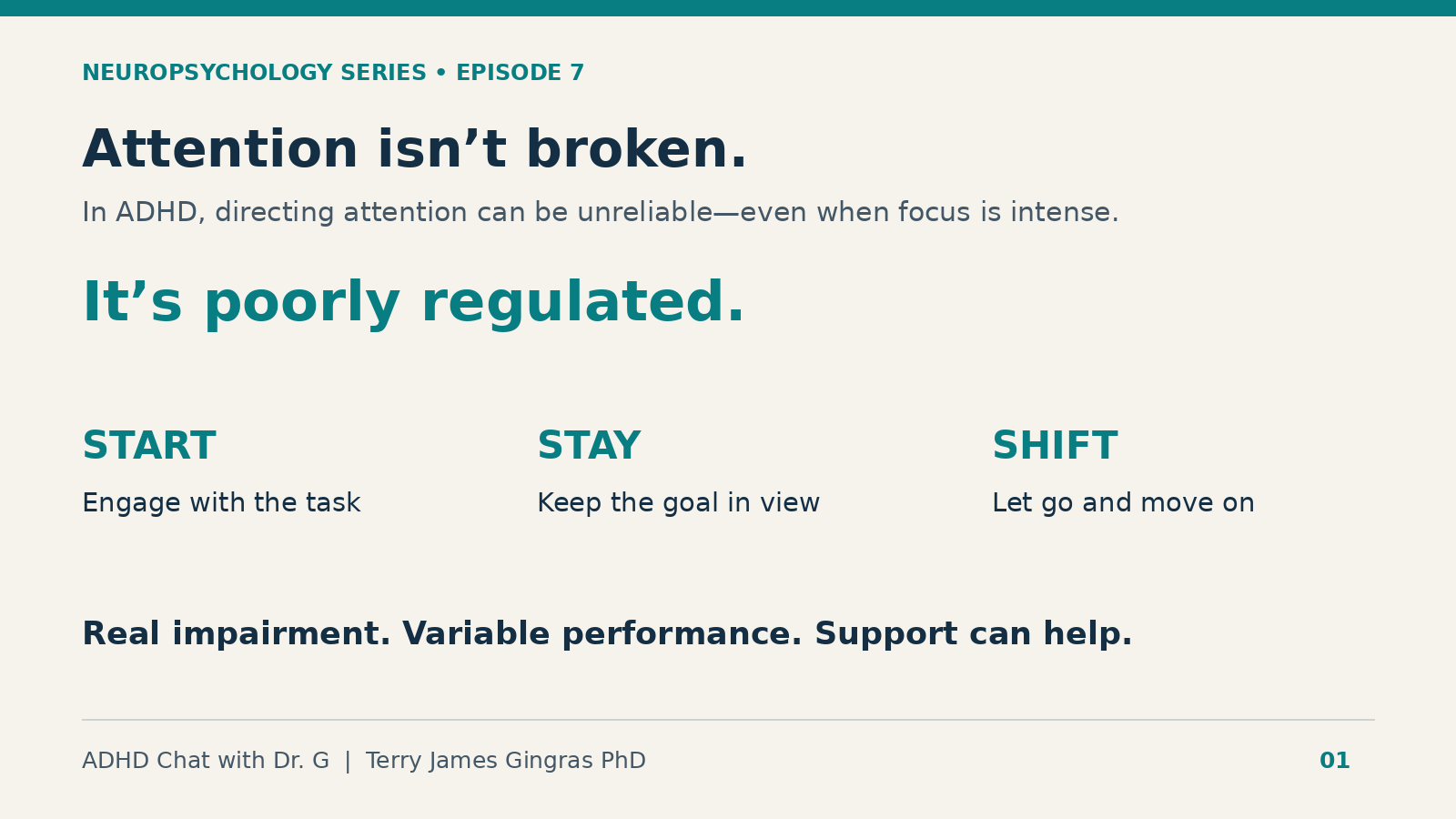
That is the point of this episode’s title: attention isn’t broken—it’s poorly regulated. This is a useful way to understand ADHD, not a claim that attention is unimpaired. The difficulties are real. The person may struggle to engage, stay engaged, or disengage when life requires it.
Attention has more than one job
We often talk about attention as if it were a light switch. Either you are paying attention or you are not.
A better picture is a spotlight with several controls. You must aim it at something, hold it there, resist competing signals, and move it when the situation changes. You also need to notice when the light has wandered.
Imagine a student completing homework. Getting started is one demand. Keeping the instructions in mind is another. Ignoring a phone notification is another. Moving from an enjoyable subject to a difficult assignment adds yet another demand.
Calling all of that “paying attention” hides how many things can go wrong.
Why attention changes with the situation
ADHD involves differences across interacting brain systems that support cognitive control, motivation, and attention. There is no single broken brain part that explains every person’s experience. Research describes group patterns; it does not provide a personal brain map for everyone with ADHD.
In daily life, a fascinating activity may supply frequent feedback and a clear next step. Paperwork may offer neither. The person can care deeply about the outcome and still struggle with the process.
That distinction matters in families. A child who stays absorbed in a game may still need substantial help completing a worksheet. A partner who follows a favorite sport closely may still lose the thread of a conversation. Neither example proves how much the person cares about you.
When attention gets stuck
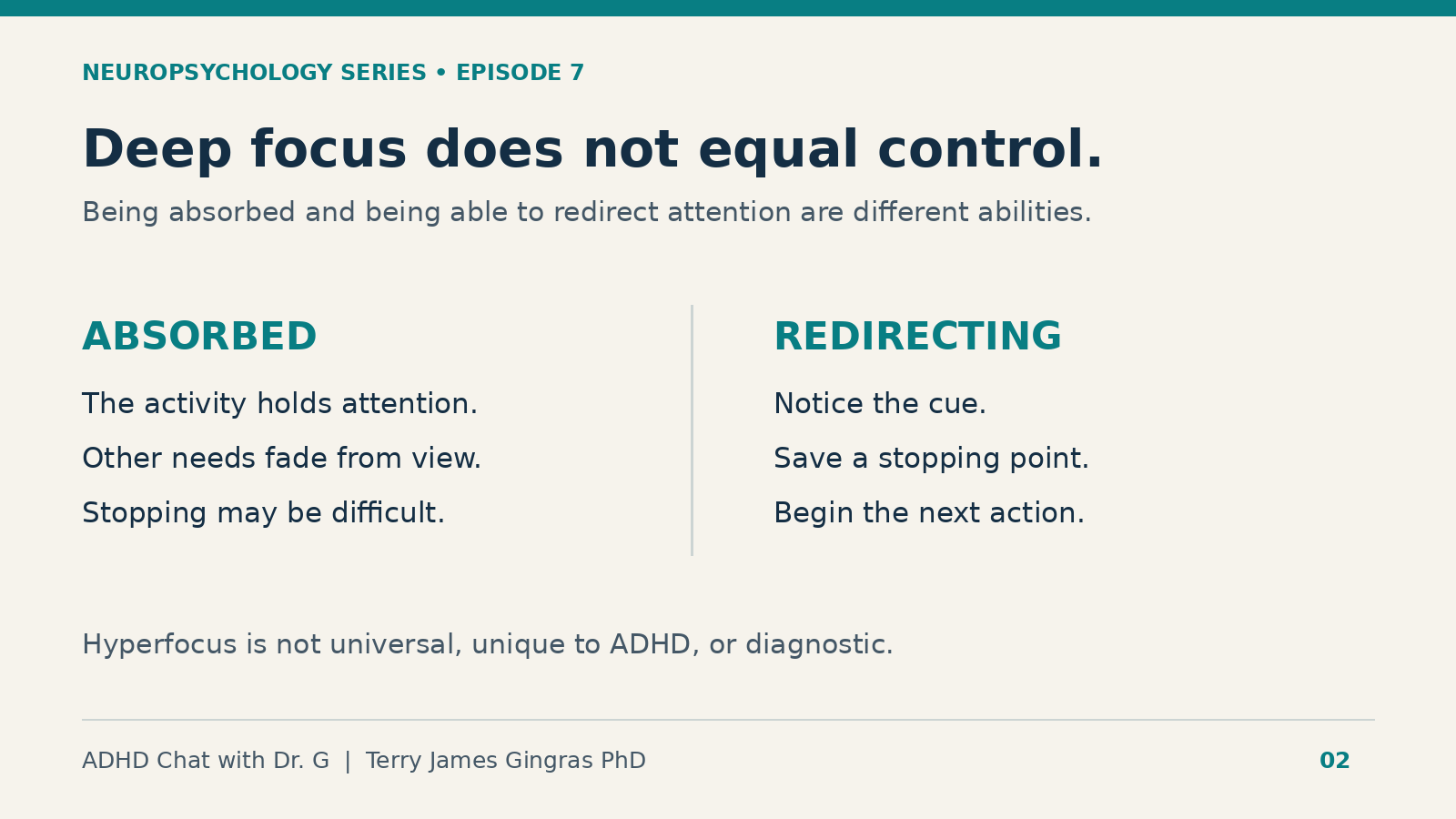
Some people describe episodes of intense absorption as hyperfocus. They may lose track of time, overlook other demands, or struggle to stop.
Being deeply absorbed is different from controlling where attention goes next. A person can stay with one activity while finding the transition away from it unusually difficult.
Hyperfocus is not experienced by everyone with ADHD, and people without ADHD experience it too. Research is still clarifying its definition and measurement. It should never serve as a diagnostic test or as proof that someone “could focus if they wanted to.”
Build supports around the task
Instead of asking only, “How can I make myself concentrate?” ask, “What would make this task easier to enter, follow, and leave?”
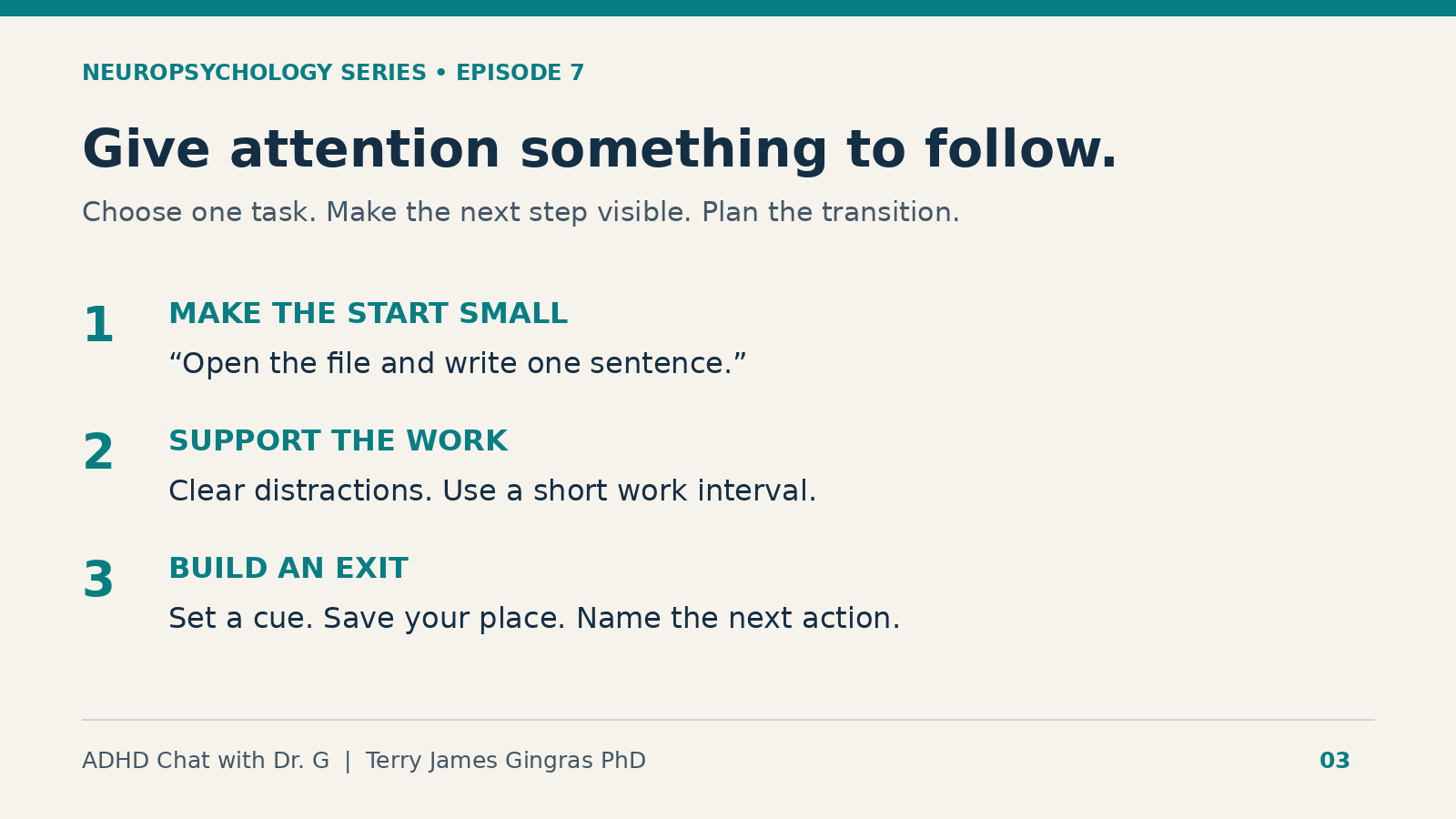
Make the start small. Replace “work on the report” with “open the file and write one sentence.” For a child, replace “clean your room” with “put the clothes in the basket.” A concrete action gives attention a target.
Reduce competing signals. Put the phone out of reach, close unrelated tabs, and keep only the materials needed for the current step in view. Choose conditions that help this particular person; background sound helps some people and distracts others.
Shorten the distance to feedback. Try a brief work interval followed by a check-in or a planned break. Start with an interval the person can manage. Notice completed steps rather than waiting until the entire project is finished.
Plan the transition. Before beginning an absorbing activity, agree on a stopping cue and the next action. When the cue arrives, save the work, write down where to resume, and begin the next step. A reminder is more useful when it tells you what to do.
Replace blame with a workable plan
Understanding attention regulation does not erase responsibilities. It helps us choose a more useful response when responsibilities are not being met.
“What got in the way, and what support should we try?” opens a different conversation from “Why don’t you ever listen?”
Practical supports complement appropriate clinical care. Medication, behavioral interventions, and other individualized treatment can help; the best approach depends on the person’s age, needs, and circumstances.
This week, choose one recurring attention problem. Make the first action visible. Remove one distraction. Plan the stopping point. Then observe what changes.
You do not have to solve every attention problem at once. Begin with one situation that could go better.
For help applying these ideas to your family or daily life, visit terrygingrasphd.com to schedule a discovery coaching call.
Responses