
Why intelligence and good intentions don't always translate into action
One of the most frustrating things about ADHD is this:
You know what to do. You intend to do it. And you still don't do it.
A child knows the homework is due tomorrow but doesn't start it.
An adult sees the electric bill sitting on the desk for six days but doesn't pay it.
An executive can develop a sophisticated strategic plan for a company, then procrastinate for three weeks over completing a routine expense report.
From the outside, this makes little sense.
From a neuropsychological perspective, it makes a great deal of sense.
The problem is the difference between knowing and doing.
Intelligence Is Not Executive Function
We tend to assume that knowing what to do should automatically lead to doing it.
It doesn't.
Knowledge depends on abilities such as memory, language, reasoning, and accumulated experience. Executive functions perform a different job. They organize behavior over time.
They help you:
-
Start.
-
Stop.
-
Remember the goal.
-
Ignore distractions.
-
Organize the steps.
-
Monitor your performance.
-
Change course when necessary.
-
Keep going when the task becomes boring.
-
Finish.
Think of executive functions as the brain's management system.
You can have excellent employees and still have a poorly managed company.
The same thing can happen in the brain.
A person can be bright, knowledgeable, creative, and highly motivated while still having difficulty consistently managing his or her own behavior.
That's the ADHD paradox.
Meet the Prefrontal Cortex
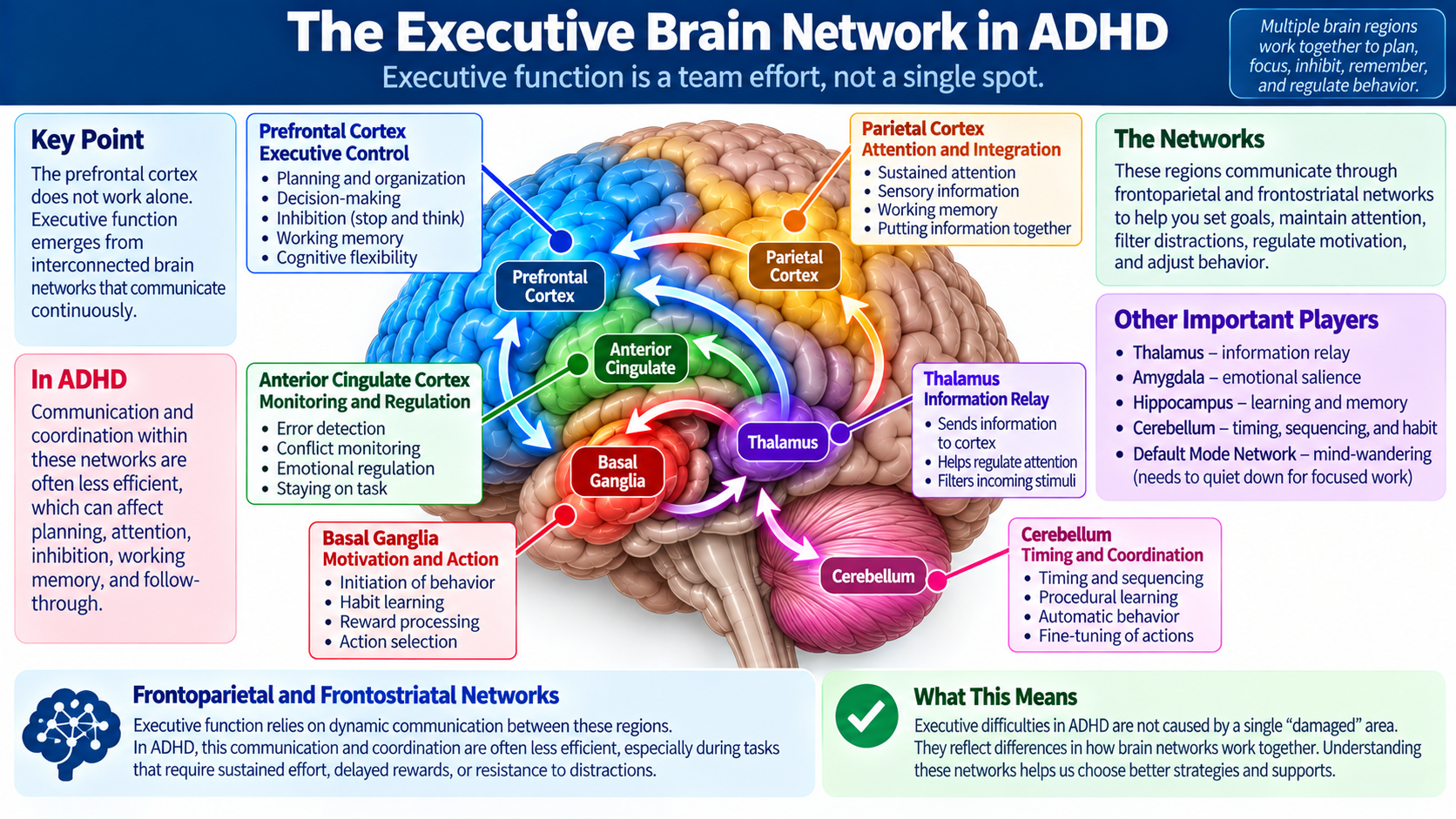
The prefrontal cortex, located behind the forehead, plays a major role in executive control.
But calling it the brain's CEO is only partly correct.
The prefrontal cortex doesn't work alone. It communicates with the parietal cortex, anterior cingulate, basal ganglia, cerebellum, and other structures through interconnected networks.
These systems help regulate working memory, inhibition, planning, attention, motivation, and behavior.
Research consistently finds executive-function weaknesses in groups of people with ADHD, particularly in working memory, inhibition, vigilance, and planning. But there is considerable individual variation. Not every person with ADHD has the same executive-function profile.
That point matters.
There is no single ADHD brain.
The Missing Bridge
Here's the distinction I want you to remember:
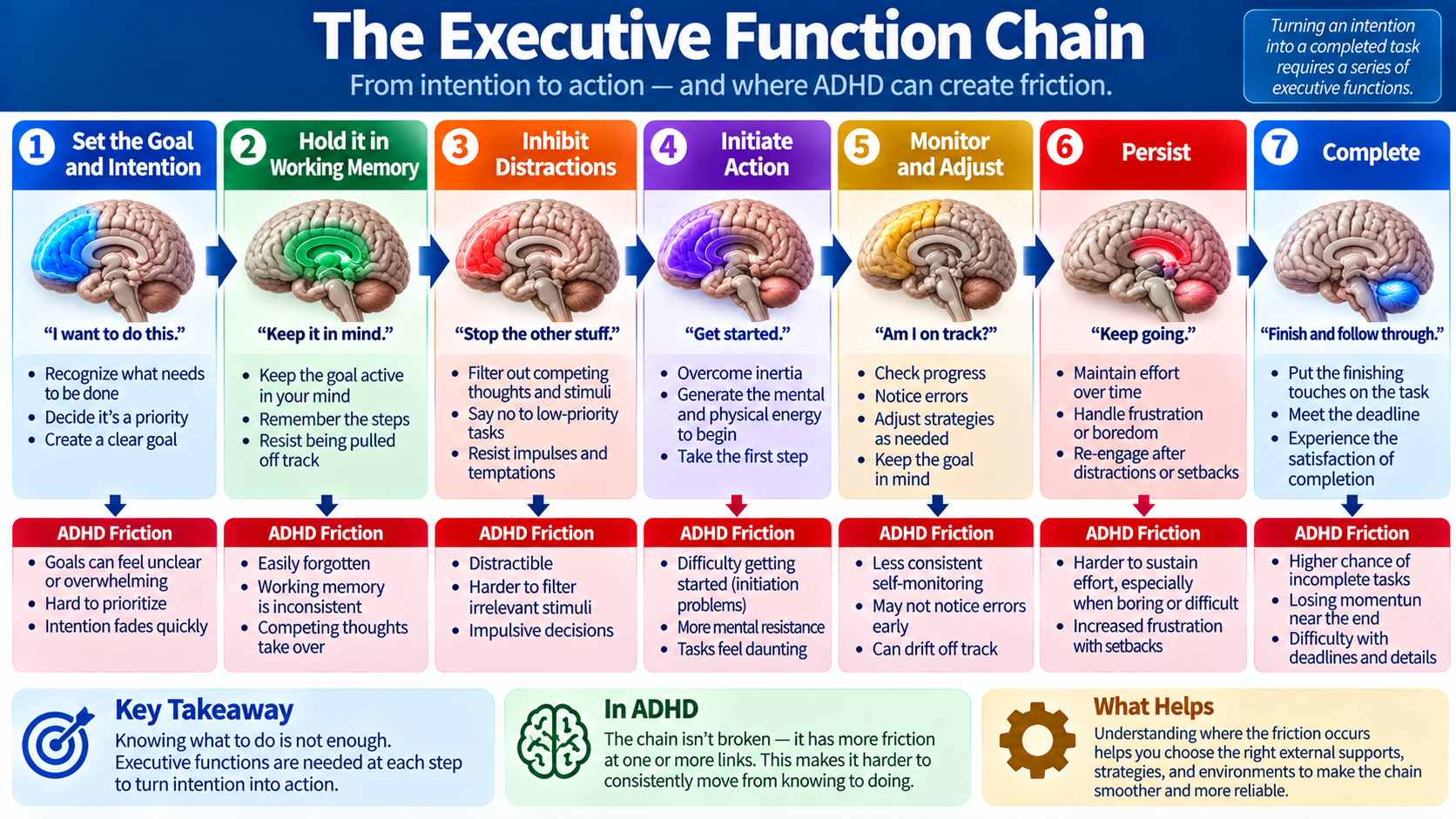
Knowing is information. Doing requires executive control.
Suppose I ask you to mail an important letter tomorrow morning.
You understand the request perfectly.
Tomorrow morning, however, you have to remember the letter, interrupt whatever you're doing, find the envelope, locate a stamp, take the letter with you, drive past the mailbox without forgetting it, and actually put it in.
That's an executive-function task.
The knowledge was easy.
Executing the intention required an entire network of cognitive processes.
For many people with ADHD, that's where things break down.
Time Makes It Harder
Executive functioning becomes particularly important when consequences are delayed.
"Finish this report and you'll benefit six months from now" doesn't create much immediate stimulation.
"Finish this report by 4:00 or we're in trouble" does.
Suddenly, attention sharpens.
Energy increases.
The person who couldn't start the project yesterday may complete it in three hours.
Parents see the same phenomenon with homework. A child procrastinates all weekend and then becomes remarkably productive Sunday night.
The brain didn't suddenly become smarter.
The environment changed.
Urgency supplied some of the activation that executive control had failed to generate earlier.
Inside the Neuropsychologist's Office
I've evaluated many intelligent adults who describe some version of the same experience:
"I know exactly what I should be doing. Why can't I make myself do it?"
That question often carries considerable shame.
The assumption is that if you know what to do and don't do it, you must be lazy, irresponsible, or insufficiently motivated.
That's a bad conclusion.
The better question is:
What is interfering with the translation of intention into action?
Once you ask that question, you can start designing solutions.
Build a Better External Brain
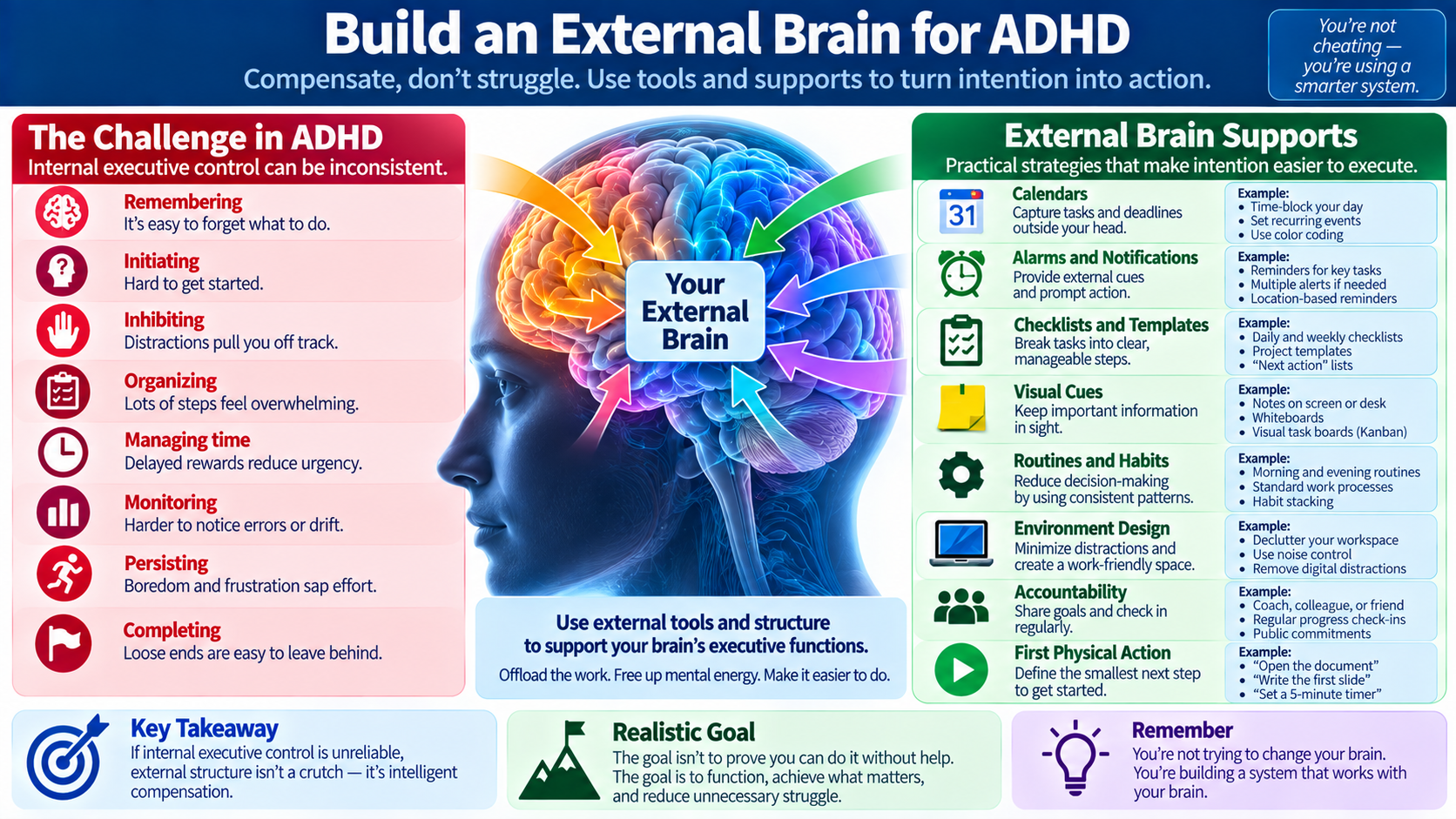
If internal executive control is inconsistent, don't rely exclusively on it.
Externalize it.
Use calendars, alarms, written plans, checklists, visible deadlines, accountability, routines, environmental cues, and smaller starting steps.
Don't tell yourself:
"Remember to do this Thursday."
Put it on the calendar.
Don't say:
"I need to work on the presentation."
Define the first physical action:
"Open the presentation and write the first slide."
The goal isn't to prove you can function without assistance.
The goal is to function.
Three Takeaways
First: ADHD doesn't mean a person doesn't know what to do. The difficulty may lie in converting knowledge and intention into consistent behavior.
Second: Executive functioning is produced by interacting brain networks, not a single spot in the frontal lobes.
Third: When executive control is unreliable, external structure isn't cheating. It's intelligent compensation.
The ADHD brain often knows exactly where it wants to go.
The challenge is building a reliable bridge between knowing and doing.
Thanks for reading and let's make the world safe for ADHD!
Visit my website at terrygingrasphd.com to learn more about Dr. G and my ADHD coaching services.
Book a discovery call to see if coaching is something you want to do. https://calendly.com/terrygingrasphd/discovery-call
DrG
Responses