
You ask your teenager to get ready. “Five more minutes,” they say. Half an hour later, they are still absorbed in a game.
An adult opens one email before leaving for an appointment. Suddenly, the appointment has already started.
Both knew the time. Both intended to leave. Somewhere between intention and action, the minutes slipped away.
That experience often gets called time blindness: difficulty sensing time passing, estimating how long something will take, and using that information to guide behavior. It is a descriptive term, not a separate diagnosis. Everyone loses track of time occasionally. With ADHD, the pattern can become frequent enough to disrupt daily life.
The clock tells only part of the story
Reading a clock is straightforward. Managing time requires more.
You must notice the clock. Hold the next obligation in mind. Estimate the remaining work. Stop the current activity. Then begin the transition.
Research finds average differences in time perception between people with ADHD and comparison groups. But laboratory timing tasks often involve seconds or fractions of seconds. They do not fully explain why someone misses a meeting or spends an hour getting out the door. Daily time management also draws on attention, memory, planning, and motivation.
The practical question is: Which part of managing time needs support?
Several brain systems share the job
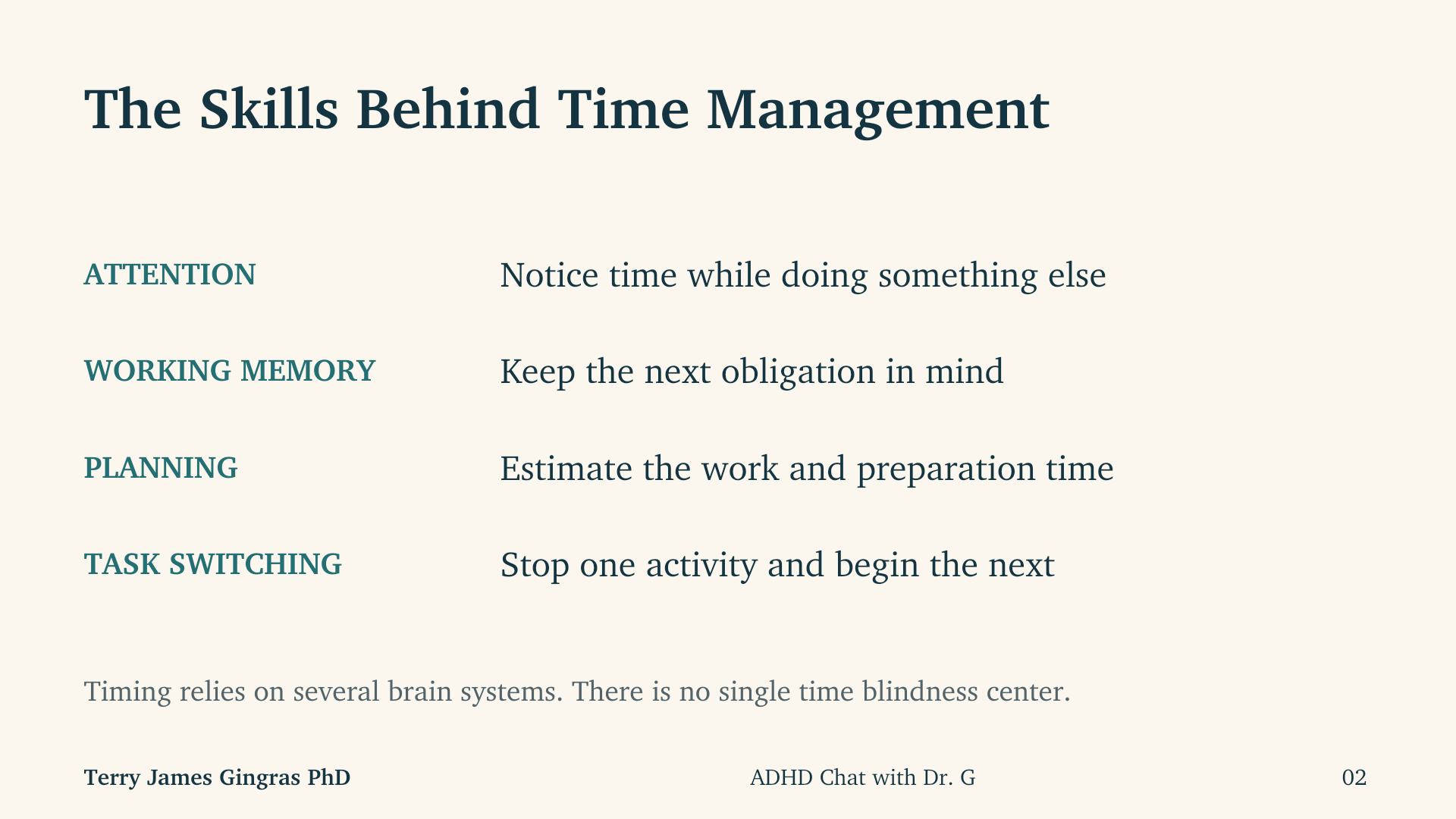
There is no single “time blindness center” in the brain.
Timing involves distributed systems, including circuits linking the frontal cortex with the basal ganglia, and contributions from the cerebellum. Executive systems help us keep goals active and organize behavior around them. Attention helps us register changing circumstances.
Think about making dinner. You must remember that the rice takes longer than the vegetables, notice when the water boils, and interrupt another activity when the timer sounds. Knowing the recipe does not automatically coordinate those steps.
The same problem appears in homework, business projects, and morning routines. A person may understand the deadline while struggling to organize the actions that make meeting it possible.
Why “later” loses its pull
Last issue explored the ADHD reward system. Here is where reward and time meet.
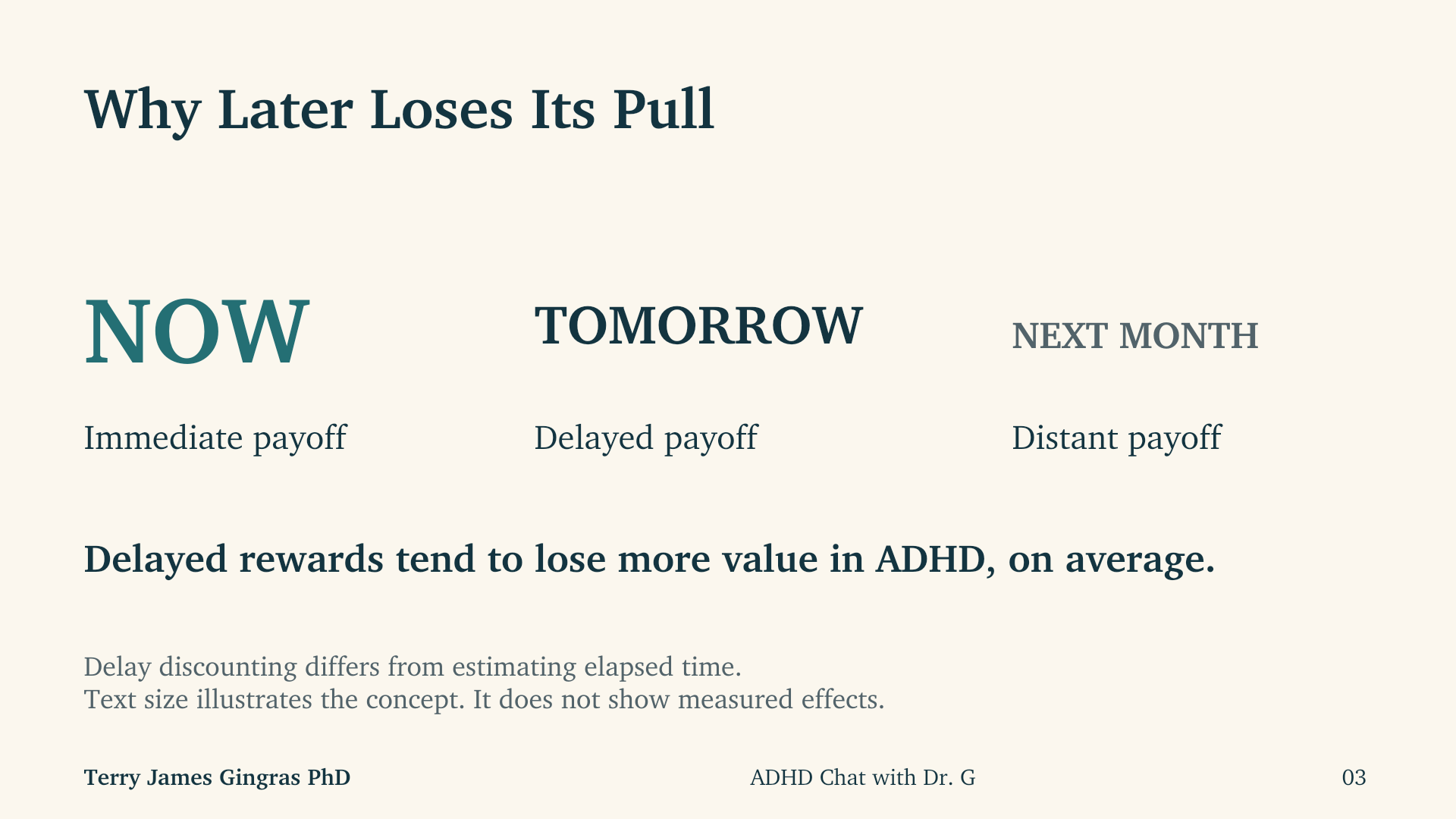
On average, people with ADHD show greater delay discounting: a tendency to give less weight to rewards that arrive later. A distant benefit can lose its influence when an immediate activity offers something more engaging.
That is related to time management, but it differs from estimating elapsed time. Someone can accurately judge ten minutes and still struggle to choose a task whose payoff is next month.
For some people, a deadline becomes compelling only when it is close. Urgency finally helps activate behavior, but the remaining time may be insufficient. The result is another rushed evening and another promise to start earlier next time.
We can help by making the next action specific and bringing feedback closer to the effort.
Four ways to make time visible
1. Measure before you plan. Choose one recurring task. Guess its duration, then time it on three occasions. Include setup and cleanup. If getting ready usually takes 35 minutes, plan around that observation. An optimistic estimate will keep producing the same rushed morning.
2. Put the passage of time in view. Try a visible countdown timer beside the activity. Choose a signal you will notice. If a phone timer leads you into messages, use a separate timer. The goal is to place useful information where you need it.
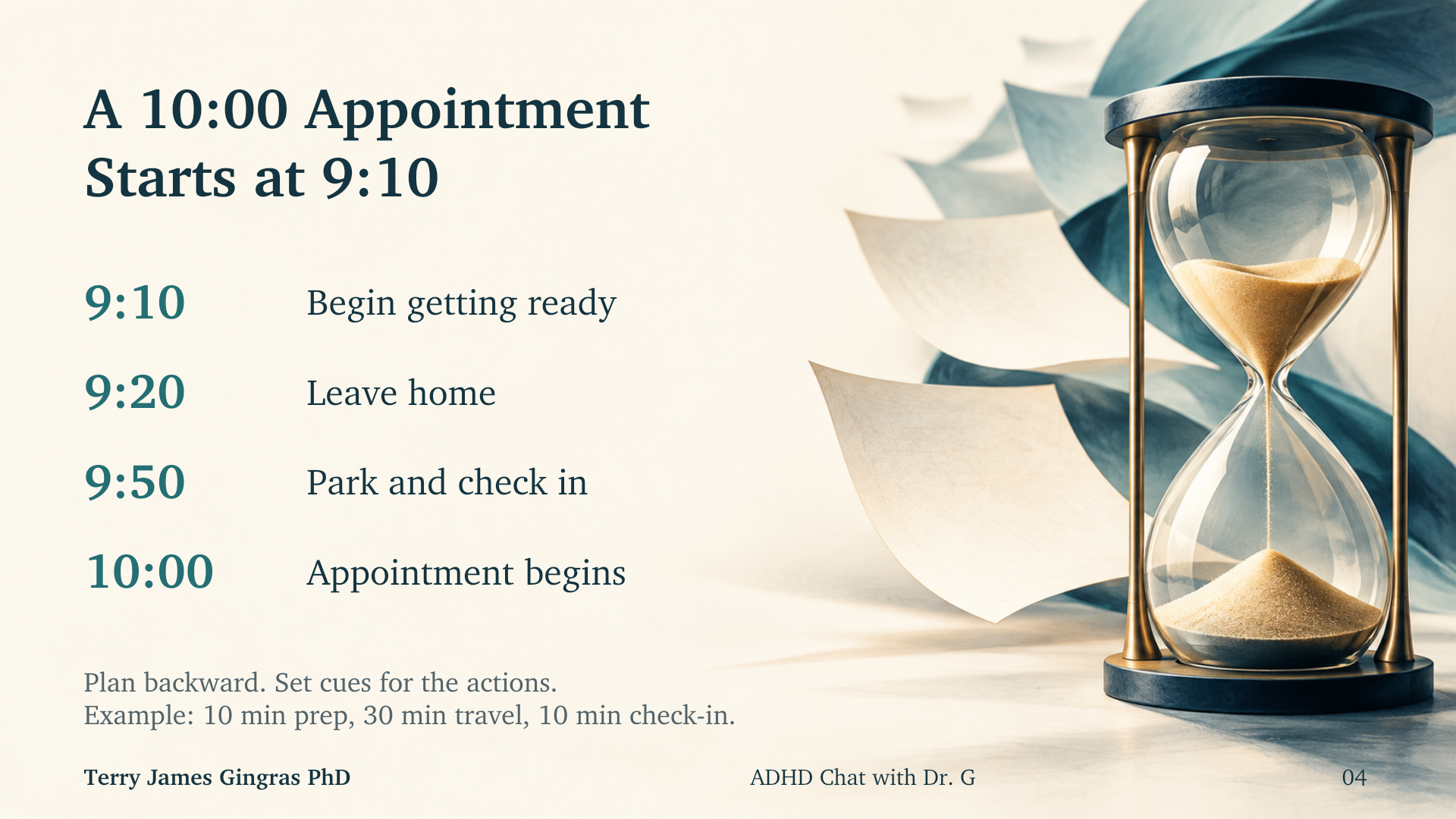
3. Plan backward from the commitment. For a 10:00 appointment, allow 30 minutes for travel and ten minutes to park and check in. That means leaving at 9:20. If preparation takes ten minutes, begin at 9:10. Set reminders for those actions, rather than relying on an alarm at the appointment time. Adjust the plan to actual travel and preparation needs.
4. Give distant work a nearer finish line. Replace “work on the report” with “draft the opening paragraph at 2:00.” Set a short work period and check what you completed. With children, acknowledge the agreed action promptly. For adults, a scheduled check-in can make progress easier to notice.
These are supports to test and adjust. Structured therapies that teach planning and organization can help adults with ADHD, but evidence for a whole treatment program does not establish that every individual timer or reminder works equally well.
This week’s experiment
Choose one troublesome transition: leaving home, starting homework, or ending work.
For five days, record the planned start time and actual start time. Use one visible timer and one reminder that names the action: “Close the laptop and get your bag.”
At the end of the week, ask: Was the estimate wrong? Did the signal go unnoticed? Was stopping the current activity the hardest part? Change the support based on the answer.
Three takeaways
-
Time management requires several skills beyond reading a clock.
-
Immediate rewards and distant deadlines can compete for attention and effort.
-
Observable durations and specific action cues give you something concrete to improve.
Next issue: Working memory: why an instruction can disappear between hearing it and acting on it.
Thanks for reading and let's make the world safe for ADHD!
Visit my website at terrygingrasphd.com to learn more about Dr. G and my ADHD coaching services.
Book a discovery call to see if coaching is something you want to do. https://calendly.com/terrygingrasphd/discovery-call
DrG
Responses