
Why an ADHD brain can struggle with one task and become completely absorbed in another
This is one of the great mysteries of ADHD.
You can't get yourself to spend 20 minutes paying bills.
BuWht you can spend four hours working on something that interests you and forget to eat lunch.
You procrastinate for three weeks on a report. Then, six hours before the deadline, you become a productivity machine.
People see these inconsistencies and conclude:
"If you can focus on that, you can focus on this."
Not necessarily.
The missing piece is reward.
Motivation Is a Brain Process
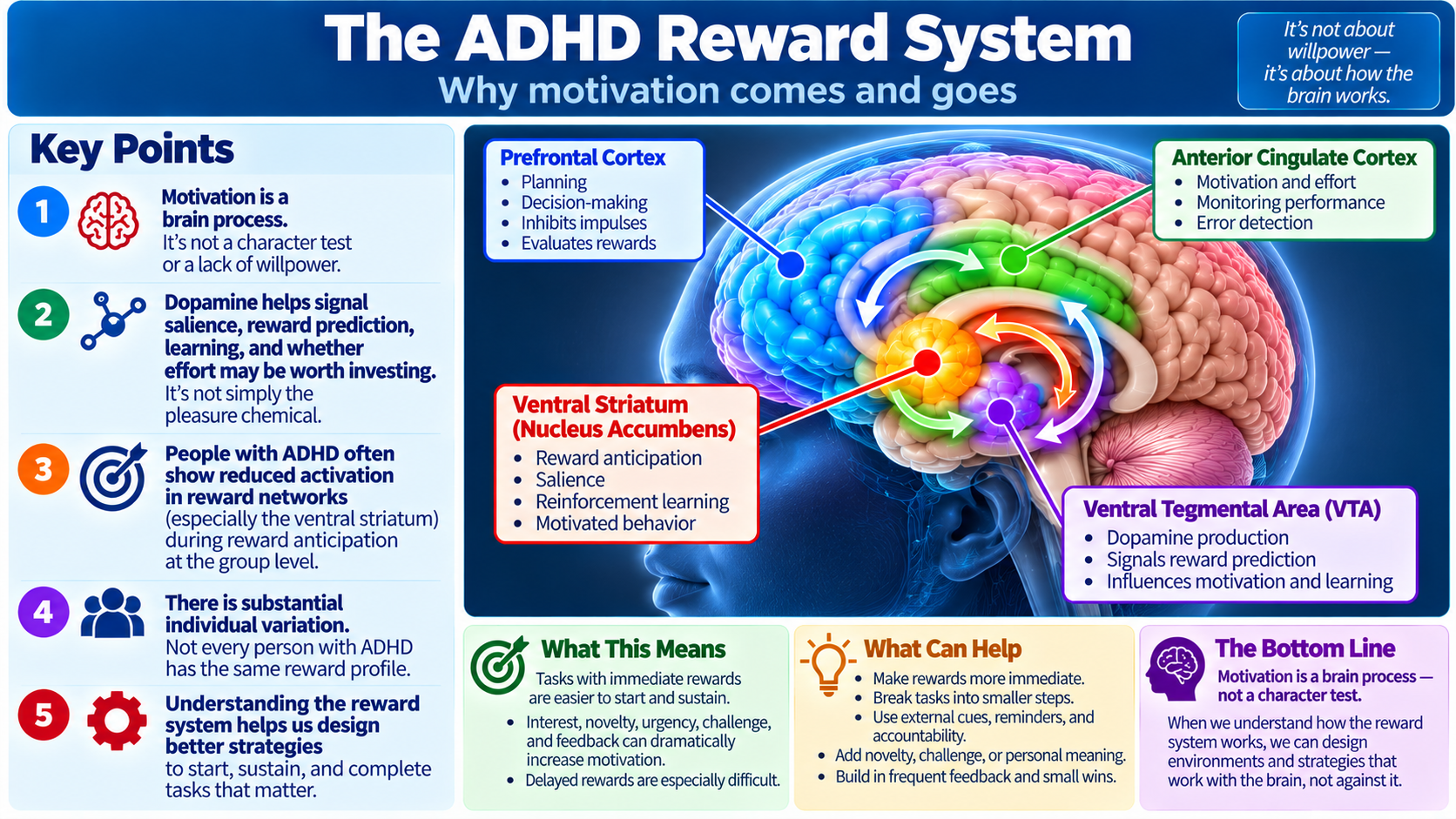
We often talk about motivation as though it were a character trait.
You're either motivated or you're not.
Neuroscience tells us something different.
Motivation emerges from interacting brain systems that evaluate a simple question:
Is this worth doing right now?
One important player is dopamine.
Dopamine is frequently called the brain's "pleasure chemical." That's catchy. It's also incomplete.
Dopamine is involved in reward prediction, reinforcement learning, salience, motivation, and deciding whether something deserves effort.
It helps the brain learn:
Pay attention. This matters. Do it again.
Meet the Reward Network
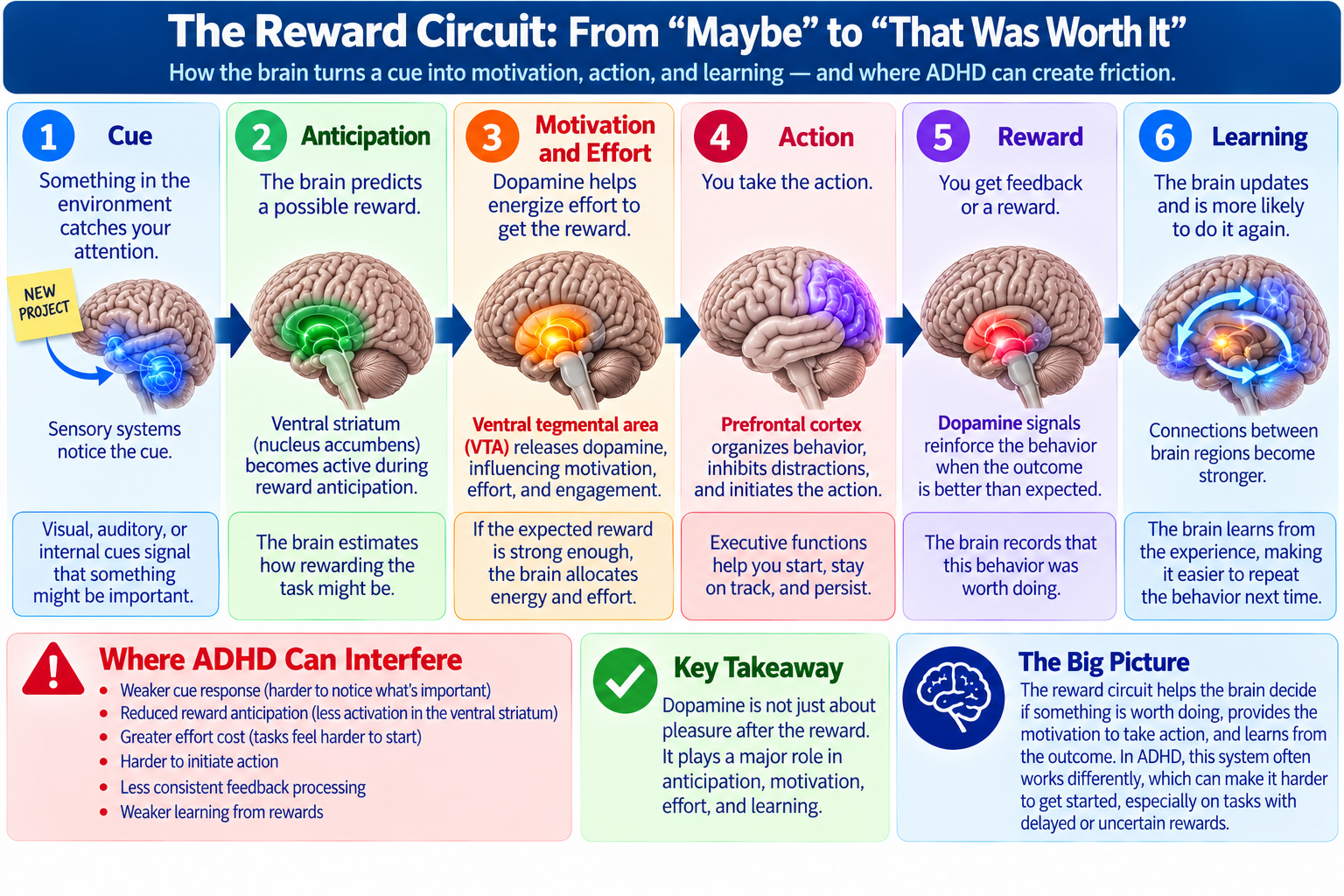
Several structures participate in reward processing.
The ventral tegmental area, or VTA, is an important source of dopamine.
The ventral striatum, including the nucleus accumbens, participates in anticipating rewards and translating their expected value into motivated behavior.
The prefrontal cortex helps evaluate consequences and pursue longer-term goals.
The anterior cingulate cortex helps evaluate effort, monitor performance, and regulate behavior.
These systems communicate continuously.
There isn't one "motivation center."
There is a network.
ADHD Changes the Reward Equation
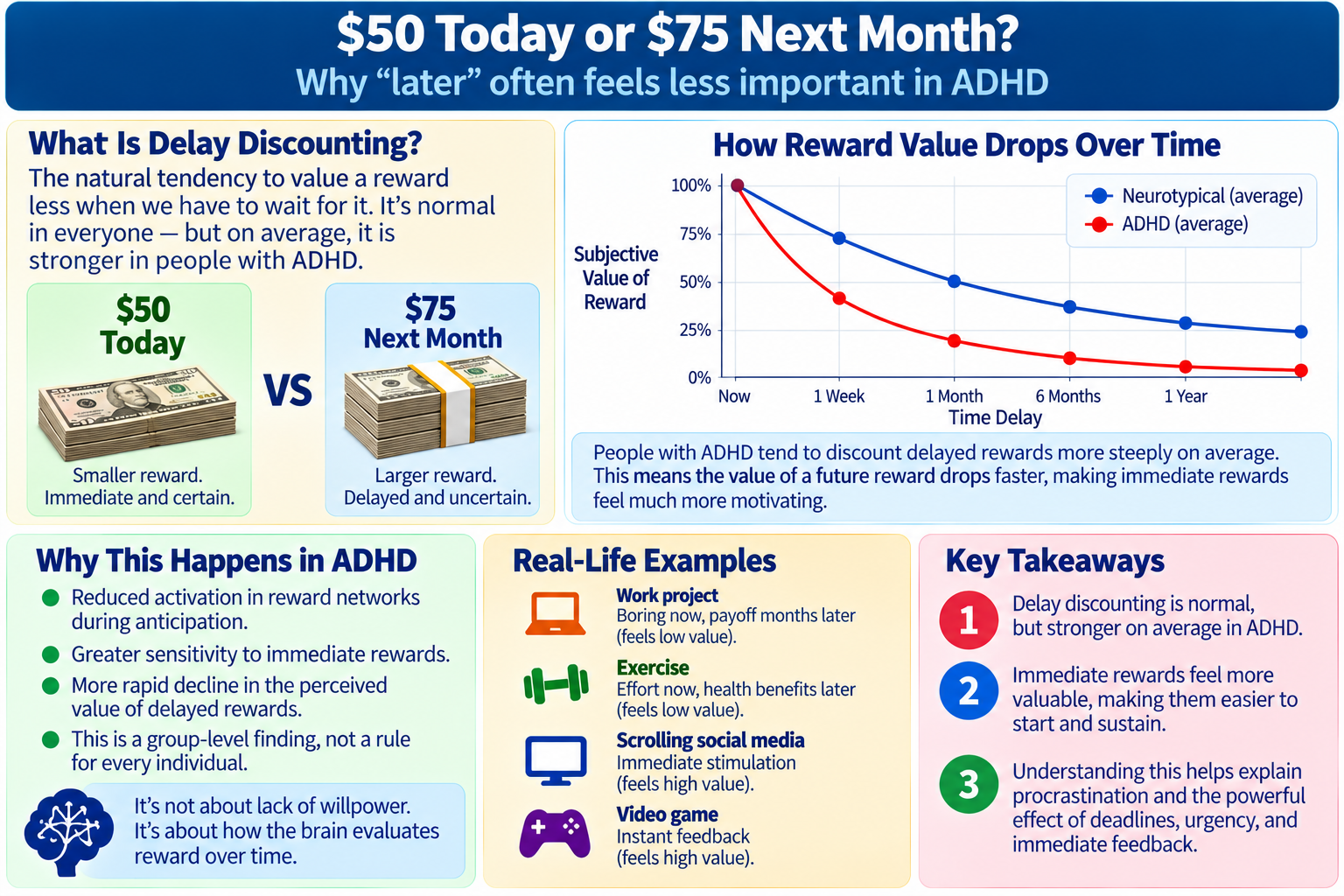
Research has found group-level differences in reward processing in ADHD. Neuroimaging studies, for example, have reported reduced ventral-striatal activation during reward anticipation in people with ADHD.
That doesn't mean every person with ADHD has an underactive reward system.
It means reward processing appears to be one important part of ADHD for many people.
Another clue comes from delay discounting.
Delay discounting is our tendency to value a reward less when we have to wait for it.
Would you rather have $50 today or $75 next month?
Everyone discounts future rewards to some degree. On average, people with ADHD tend to discount delayed rewards more steeply.
And that has enormous implications for everyday life.
"Someday" Is a Weak Reward
Consider two tasks.
Task A: Finish this tedious report today and perhaps receive a good performance review six months from now.
Task B: Solve this fascinating problem right now and immediately see whether your solution works.
Which one generates more activation?
For many people with ADHD, Task B wins easily.
The first task may be more important.
The second is more immediately rewarding.
This helps explain why interest, novelty, urgency, challenge, and immediate feedback can dramatically change performance.
The brain hasn't suddenly acquired more intelligence.
The reward equation changed.
Why Deadlines Work So Well
Now let's return to that report you've avoided for three weeks.
At 9:00 Monday morning, the deadline was Friday.
Little urgency.
Little immediate consequence.
Plenty of competing stimulation.
Thursday night arrives.
Suddenly the deadline is tomorrow.
Now there is urgency.
Immediate consequences.
Emotional activation.
The task has become more salient.
And you're off.
This is why some people with ADHD become dependent on crisis.
They're not necessarily seeking chaos.
Urgency is supplying activation.
Unfortunately, constantly manufacturing emergencies is an exhausting way to run a life.
Inside the Neuropsychologist's Office
I've heard countless variations of this question:
"How can I be incredibly productive when I'm interested in something and completely useless when I'm not?"
The person often interprets that inconsistency as a moral failure.
I don't.
I want to know what changes between those situations.
Is the successful task novel?
Challenging?
Competitive?
Personally meaningful?
Immediately rewarding?
Does it provide rapid feedback?
Does someone else expect the result?
Those questions tell us something important.
Instead of simply demanding more motivation, we can engineer conditions that help produce it.
Don't Wait for Motivation
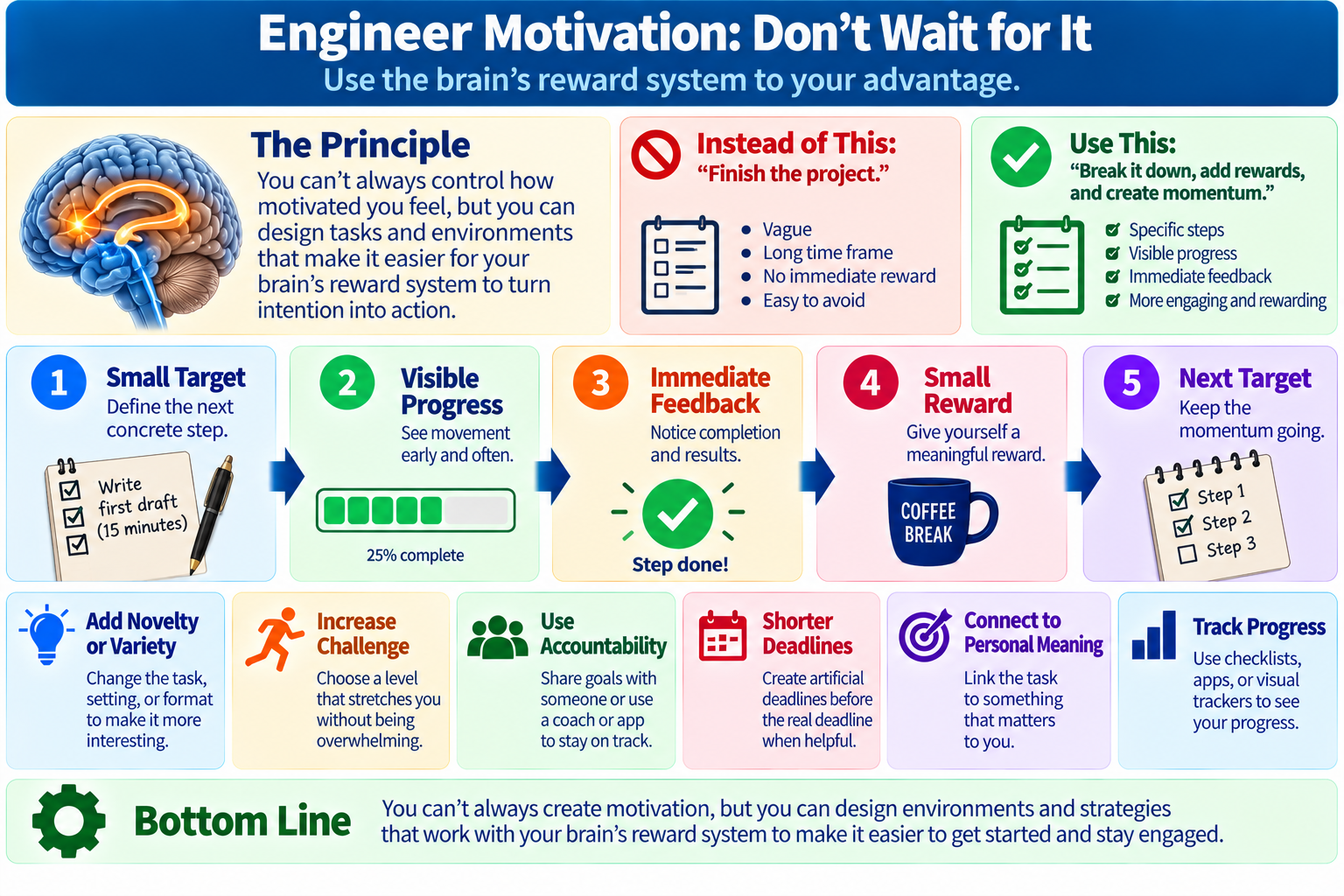
This is where understanding neuroscience becomes useful.
Make rewards more immediate.
Break long projects into short targets.
Create visible progress.
Use accountability.
Add deadlines before the real deadline.
Turn vague tasks into specific actions.
Add challenge or novelty when possible.
Connect boring tasks to something personally meaningful.
And don't underestimate the power of simply checking something off a list.
Small completions create feedback.
Feedback helps maintain behavior.
What About Medication?
ADHD medication adds another piece to the puzzle.
Stimulant medications such as methylphenidate and amphetamine increase dopamine and norepinephrine signaling through somewhat different mechanisms. These neurotransmitters influence executive, attentional, and reward-related networks.
But medication doesn't pour "missing dopamine" into an empty ADHD brain.
That's far too simple.
Treatment changes signaling within complex neural systems, which can improve the brain's ability to regulate attention and behavior.
Three Takeaways
First: Motivation is not simply willpower. It emerges partly from brain systems that evaluate reward, effort, and consequences.
Second: ADHD is associated with differences in reward anticipation and a greater tendency, on average, to favor immediate over delayed rewards.
Third: Instead of repeatedly saying "try harder," change the reward environment. Make progress visible, consequences closer, tasks smaller, and feedback faster.
Sometimes the best ADHD intervention isn't creating more discipline.
It's changing what the brain gets rewarded for—and when.
Next Issue
Time Blindness: Why the ADHD Brain Struggles With the Future
We'll look at time perception, prospective memory, delayed consequences, and why "later" can be such a dangerous word for an ADHD brain.
Thanks for reading and let's make the world safe for ADHD!
Visit my website at terrygingrasphd.com to learn more about Dr. G and my ADHD coaching services.
Book a discovery call to see if coaching is something you want to do. https://calendly.com/terrygingrasphd/discovery-call
DrG
Responses